2 minutes
Part 3: Influence Maps: Turning the Fight Into a Heatmap
Visibility tells you whether a place can be seen.
Influence maps tell you how much pressure exists there.
That difference matters. A position can be visible without being dangerous, and dangerous without being fully visible. Influence maps help estimate the shape of the fight instead of only the geometry of the map.
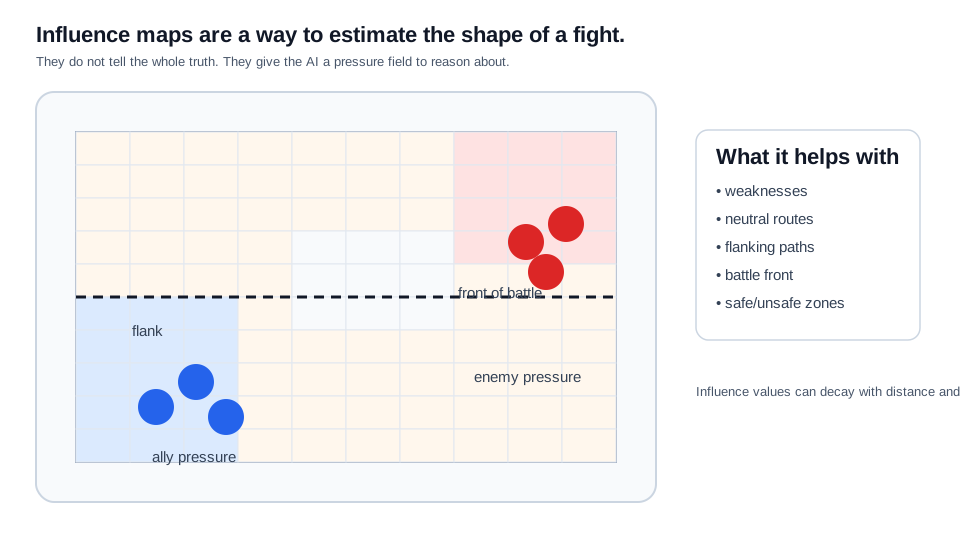
What an influence map is
An influence map is a grid layered over the terrain. Each cell stores a value that represents power, danger, control, or importance.
The value usually comes from units or other sources, and it falls off with distance. Nearby cells matter more than distant ones.
That gives the AI a smooth tactical field to reason about.
What the map helps with
Influence maps are useful when the AI needs to answer questions like:
- where is the strongest enemy presence?
- where is the weakest point in the line?
- what route avoids the center of the fight?
- where is a good flank?
- where is the front of the battle?
The map does not give perfect answers. It gives a good estimate. That is often enough for decision-making.
Combining multiple sources
Influence is rarely coming from one source.
Friendly units, enemy units, objectives, and terrain features can all contribute. The final map is a combination of those signals.
That is what makes the technique useful in both combat and non-combat systems.
The same idea can model crime, pollution, police coverage, fire coverage, or traffic pressure. Any system with spatial force or pressure can use the pattern.
Why it is useful
Influence maps sit between exact pathfinding and high-level strategy.
Pathfinding finds a route. Influence maps help decide whether that route is smart.
That makes them a strong middle layer for tactical AI.
Practical takeaway
Use influence maps when the AI needs a broad read on the battlefield.
They are not a substitute for line-of-sight checks or pathfinding. They are a way to estimate where the fight is strong, weak, safe, or dangerous.
The next step is to store more than one tactical signal at once.