12 minutes
Builder and Fluent Builder Patterns: Make Setup Readable Without Hiding the Cost

Builder APIs are useful when object setup has more rules than a constructor can explain.
That is the short version. The longer version is where people usually get into trouble. A builder can make complicated setup readable, guide callers through valid options, and keep construction code out of gameplay logic. It can also turn three obvious assignments into a maze of chained methods that nobody wants to debug at 2 a.m.
Game code hits both sides often. We build weapons from data, spawn enemies with tuning overrides, configure UI widgets, assemble VFX requests, create test fixtures, and send messages across network or service boundaries. Some of those objects deserve a builder. Most do not.
Writing a builder is easy. Deciding whether the extra type earns its keep is the real work.
What a builder is actually buying you
A builder separates configuration from creation.
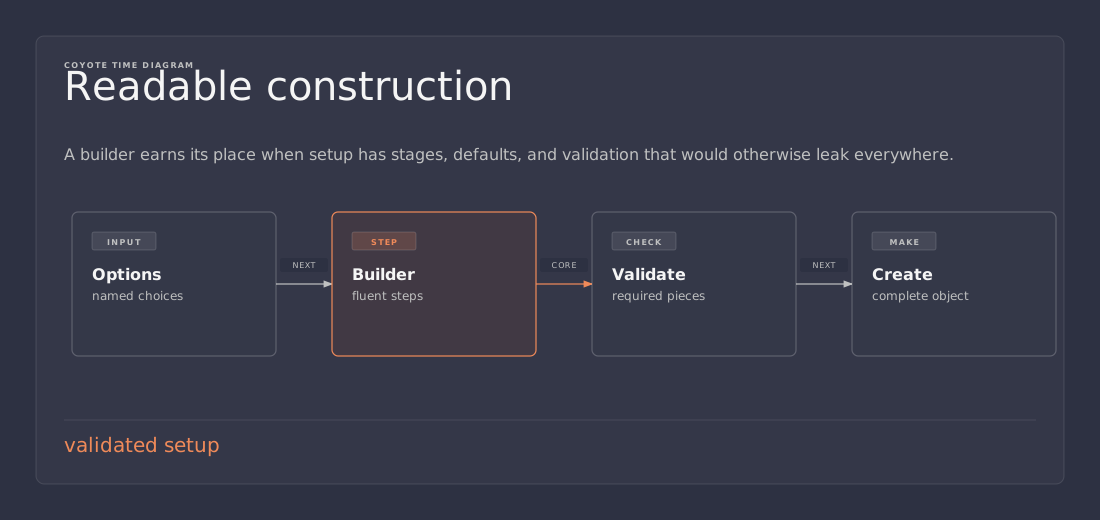
Instead of forcing every option through one constructor, the caller fills in a small construction object. When the configuration is complete, the builder creates the final object in one place. A fluent builder is the same idea with methods that return the builder so calls can be chained.
The shape usually looks like this:
var projectile = new ProjectileBuilder(prefab)
    .WithOwner(player)
    .WithDamage(25)
    .WithSpeed(40f)
    .WithLifetime(3f)
    .Build();
This is not automatically better than a constructor or object initializer. It is better only if the construction step needs help.
A builder can help when:
- some options are required and others are optional
- the valid combinations are not obvious
- defaults should be centralized
- construction needs validation before the object exists
- the final object should be immutable after creation
- call sites are currently full of noisy setup code
- tests need clear, reusable fixture setup
Those are real problems. A builder gives them a home.
But if the class has two required values and no invariants, a builder is decoration. Decoration is more code to read.
Start with the boring options first
Before writing a builder, check whether C# already gives you the shape you need. It often does.
For simple data carriers, an object initializer is hard to beat:
var spawn = new EnemySpawnRequest
{
    EnemyId = "grunt",
    Position = spawnPoint.position,
    Level = 3,
    AggroRadius = 12f
};
That is readable, searchable, and unsurprising. If the type uses C# required members, the compiler can force the important fields to be set:
public sealed class EnemySpawnRequest
{
    public required string EnemyId { get; init; }
    public required Vector3 Position { get; init; }
    public int Level { get; init; } = 1;
    public float AggroRadius { get; init; } = 8f;
}
For many request objects, that is enough. No builder. No chain. No private mutable state hiding in another type.
Records and init properties can cover the same ground when you want values that are easy to copy with small changes:
var eliteSpawn = baseSpawn with
{
    EnemyId = "elite_grunt",
    Level = 8
};
That is useful for tools, tests, and data transformations. It is not always the right fit for Unity runtime objects, especially if serialization or engine object lifetimes are involved, but the point stands: use the language feature when the language feature solves the problem.
A builder should appear after these simpler tools stop carrying the weight.
The constructor problem builders actually solve
Constructors become painful when optional values pile up.
This is the warning sign:
var weapon = new WeaponDefinition(
    "burst_rifle",
    30,
    0.08f,
    1.6f,
    true,
    false,
    null,
    2.5f,
    0.35f);
Nobody wants to review that call. The compiler knows the types, but the reader has to count arguments and remember what each number means. Named arguments can help:
var weapon = new WeaponDefinition(
    id: "burst_rifle",
    damage: 30,
    fireInterval: 0.08f,
    reloadSeconds: 1.6f,
    usesBurstFire: true,
    isSuppressed: false,
    projectileOverride: null,
    spreadDegrees: 2.5f,
    recoilKick: 0.35f);
Named arguments may be all I need.
A builder earns a place when the setup is not just long, but stateful. Maybe burst fire requires a burst count. Maybe hitscan weapons cannot use projectile prefabs. Maybe reload time should default from magazine size unless explicitly overridden. Maybe a tool wants to assemble definitions from several data sources and validate once at the end.
At that point, a constructor is doing too much work at the wrong level. The builder gives construction its own workspace.
A builder that keeps the rules in one place
Here is a small version for a weapon definition. I kept it ordinary on purpose.
public sealed class WeaponDefinition
{
    public string Id { get; }
    public int Damage { get; }
    public float FireInterval { get; }
    public int MagazineSize { get; }
    public int BurstCount { get; }

    public WeaponDefinition(
        string id,
        int damage,
        float fireInterval,
        int magazineSize,
        int burstCount)
    {
        Id = id;
        Damage = damage;
        FireInterval = fireInterval;
        MagazineSize = magazineSize;
        BurstCount = burstCount;
    }
}

public sealed class WeaponDefinitionBuilder
{
    private readonly string id;
    private int damage = 10;
    private float fireInterval = 0.2f;
    private int magazineSize = 12;
    private int burstCount = 1;

    public WeaponDefinitionBuilder(string id)
    {
        this.id = string.IsNullOrWhiteSpace(id)
            ? throw new ArgumentException("Weapon id is required.", nameof(id))
            : id;
    }

    public WeaponDefinitionBuilder WithDamage(int value)
    {
        damage = value;
        return this;
    }

    public WeaponDefinitionBuilder WithFireInterval(float seconds)
    {
        fireInterval = seconds;
        return this;
    }

    public WeaponDefinitionBuilder WithMagazineSize(int value)
    {
        magazineSize = value;
        return this;
    }

    public WeaponDefinitionBuilder AsBurstFire(int count)
    {
        burstCount = count;
        return this;
    }

    public WeaponDefinition Build()
    {
        if (damage <= 0)
            throw new InvalidOperationException("Damage must be positive.");

        if (fireInterval <= 0f)
            throw new InvalidOperationException("Fire interval must be positive.");

        if (magazineSize <= 0)
            throw new InvalidOperationException("Magazine size must be positive.");

        if (burstCount <= 0 || burstCount > magazineSize)
            throw new InvalidOperationException("Burst count must fit inside the magazine.");

        return new WeaponDefinition(
            id,
            damage,
            fireInterval,
            magazineSize,
            burstCount);
    }
}
This builder is boring. That is why I like it.
The final object is immutable from the outside. Defaults live in one place. Validation happens before the definition enters the rest of the game. The call site reads like intent instead of a bag of numbers:
var rifle = new WeaponDefinitionBuilder("burst_rifle")
    .WithDamage(30)
    .WithFireInterval(0.08f)
    .WithMagazineSize(36)
    .AsBurstFire(3)
    .Build();
If that construction appears in test code, import code, or a balancing tool, the readability win can be worth the extra type.
If it appears once in production code, it probably is not.
Fluent does not mean free
Fluent APIs feel nice because they read in order. That is also why they are dangerous. A fluent chain can make bad abstractions look smooth.
This is the version to avoid:
new EnemyBuilder()
    .WithBrain()
    .WithMovement()
    .WithHealth()
    .WithLoot()
    .WithAnimations()
    .WithAudio()
    .WithEverythingElse()
    .Build();
That does not explain construction. It hides it.
A builder method should describe a meaningful choice. WithDamage(20) is useful. WithHealth() is suspicious unless there are clear options behind it. WithEverythingElse() is the builder waving a tiny red flag.
Fluent APIs also make debugging slightly less direct. A normal block of assignments lets you put a breakpoint on each line and inspect the object as it changes. A chain can still be debugged, but it encourages readers to treat setup as one expression. Simple chains are fine. It gets annoying when a chain starts doing real work.
So keep fluent builders boring:
- methods should set values, not perform expensive work
Build()should be the place where creation happens- validation should be obvious and deterministic
- method names should describe game concepts, not implementation steps
- chains should stay short enough to scan
If a builder needs logging, async calls, asset loading, scene searches, or service lookup inside every With... method, it is no longer a simple builder. It is a workflow object pretending to be a builder. Name it honestly or simplify it.
Unity changes the tradeoff
Unity code has a few construction traps that plain C# examples skip.
First, MonoBehaviour objects are not created with new. The engine owns their lifecycle. A builder that tries to construct components like normal C# objects will fight the platform.
Second, prefabs and ScriptableObject assets already solve a lot of configuration problems. If a designer needs to tune weapon data, enemy stats, or UI theme values, a serialized asset is usually a better source of truth than a hardcoded builder chain. Builders are code. Designers need data.
That does not make builders useless in Unity. It just narrows where they belong.
Good Unity fits include:
- building plain C# request objects before passing them to systems
- assembling immutable runtime definitions from imported data
- creating test fixtures without scene setup
- constructing editor-tool commands
- validating data during import or bake steps
- wrapping prefab instantiation options into a clear request
Poor Unity fits include:
- replacing prefabs with code-only construction for designer-owned content
- hiding
Instantiatecalls and scene dependencies in fluent chains - building
MonoBehaviourgraphs as if they were normal objects - adding a builder around every small serializable class
My rule is simple: let Unity assets handle data that should be edited as content. Use builders for code-owned construction rules.
A spawn request is usually better than a spawn builder
Spawning is where builders often look tempting and then become unnecessary.
A gameplay system might need this:
public readonly record struct SpawnRequest(
    string EnemyId,
    Vector3 Position,
    Quaternion Rotation,
    int Level,
    Team Team);
The spawn system can validate the request and perform the work:
spawner.Spawn(new SpawnRequest(
    EnemyId: "grunt",
    Position: spawnPoint.position,
    Rotation: spawnPoint.rotation,
    Level: wave.Level,
    Team: Team.Enemy));
This is clean enough. Adding new SpawnRequestBuilder().At(...).Facing(...).ForTeam(...).Build() may not improve anything.
Use a builder only when the request has enough conditional rules to justify it. For example, a roguelike room generator might layer biome defaults, difficulty scaling, elite modifiers, and encounter tags before creating the final spawn plan. The builder is useful because it acts as a staging area for rules.
For one enemy at one transform, just pass the request.
Builders are excellent in tests
One place builders pay for themselves quickly is test setup.
Tests often need valid objects where only one value matters to the test. Without a builder, every test repeats the same boring constructor data. When the object changes, every test breaks for reasons unrelated to the behavior being tested.
A small test data builder fixes that:
public sealed class PlayerStatsBuilder
{
    private int maxHealth = 100;
    private int armor = 0;
    private float moveSpeed = 6f;

    public PlayerStatsBuilder WithMaxHealth(int value)
    {
        maxHealth = value;
        return this;
    }

    public PlayerStatsBuilder WithArmor(int value)
    {
        armor = value;
        return this;
    }

    public PlayerStats Build()
    {
        return new PlayerStats(maxHealth, armor, moveSpeed);
    }
}
Then a test can say what it cares about:
var stats = new PlayerStatsBuilder()
    .WithMaxHealth(1)
    .Build();
This works because the builder hides irrelevant defaults, not important behavior. The test still tells the reader why this object is special.
The same idea works for gameplay simulations. If a combat test needs a poisoned enemy with low health and no armor, a fixture builder can make that setup obvious without dragging in every unrelated field.
Just do not let test builders leak into production API design automatically. Tests benefit from convenience. Production code benefits from clear boundaries.
Type-safe staged builders are rarely worth it
There is a more advanced version of the pattern where the type system forces calls to happen in a specific order. For example, you cannot call Build() until WithOwner() and WithPrefab() have both been called.
That can be valuable for public libraries or dangerous workflows. In game code, it is often overkill.
A staged builder tends to create several small interfaces or generic types:
SpawnBuilder
    .ForPrefab(prefab)   // returns an interface that now allows WithOwner
    .WithOwner(player)   // returns an interface that now allows At
    .At(position)        // returns an interface that now allows Build
    .Build();
It is neat. It is also more machinery than most teams need.
For internal game systems, clear constructor requirements plus runtime validation are usually enough. The code is easier to change, and the error messages can mention the actual content problem instead of presenting a wall of generic type errors.
Use staged builders when invalid call order would be common, expensive, and hard to diagnose. Otherwise, keep the builder simple and let Build() validate.
Watch for hidden mutable state
A builder is usually mutable. That is fine as long as it is treated as a short-lived construction object.
Problems start when builders are reused across calls:
private readonly ProjectileBuilder projectileBuilder = new(projectilePrefab);

public Projectile Fire(Vector3 direction)
{
    return projectileBuilder
        .WithDirection(direction)
        .WithDamage(currentDamage)
        .Build();
}
That looks efficient, but now the builder is carrying state between shots. If one call sets an optional value and the next call does not reset it, the second projectile may inherit stale configuration. If multiple systems touch the same builder, the bug gets worse.
The safest default is to create builders near the call site and throw them away after Build(). They are tiny objects. If allocation matters in a hot path, that is a signal to avoid the builder there, not to keep a mutable builder singleton around.
Hot paths usually want explicit structs, precomputed data, pools, or command buffers. A fluent builder is primarily an API clarity tool, not a per-frame performance trick.
A quick decision checklist
Before adding a builder, ask these questions:
- Would an object initializer or named arguments be clear enough?
- Does construction have validation rules that belong in one place?
- Are there enough optional settings to make constructors noisy?
- Does the final object benefit from being immutable after creation?
- Will this setup appear in enough places to justify a reusable API?
- Is this code-owned setup, or should it be designer-owned data?
- Will the builder stay short, boring, and easy to debug?
If the answer to the first question is yes, stop there. That is maintenance discipline.
If several later answers are yes, a builder can be a good fit.
The practical takeaway
I use builders to give complicated setup a small, honest workspace, not to make object creation look fancy.
Use a builder when construction has defaults, validation, optional combinations, or repeated setup noise that would otherwise leak into gameplay code. Keep the final object simple. Keep Build() responsible for validation and creation. Keep fluent methods boring. Do not use a builder to hide Unity lifecycle rules, asset loading, or scene wiring.
Most game objects do not need builders. The ones that do usually show the pain clearly: the constructor call is unreadable, the setup rules are scattered, or the tests are drowning in irrelevant fixture data.
I reach for the smallest tool that makes the construction rules visible. Sometimes that is a builder. Usually it is a good constructor, an object initializer, or a plain request type.
References
- Microsoft Learn: Object and collection initializers
- Microsoft Learn:
requiredmodifier - Microsoft Learn: Records in C#
- Martin Fowler: Fluent Interface
- Unity Manual: ScriptableObject
- Robert Nystrom: Game Programming Patterns — Prototype